Palestine Scholars
Archive Launched to Honour Palestinian Scholars Killed in Gaza
[Reproduction of article published by British Committee for the Universities of Palestine, March 2026]
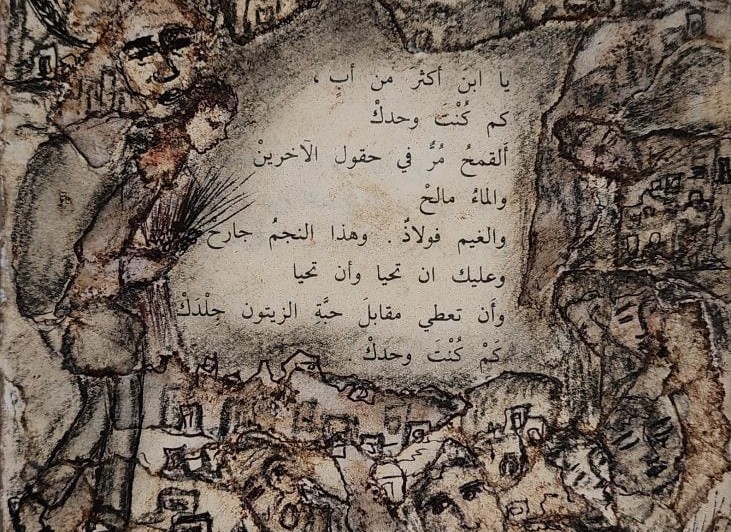
Image: extract from How Alone You Were (2025); Fatima Ali Abu Owdah
An evolving archive invites scholars and institutions worldwide to help preserve the memory of murdered academics.
A group of international academics who have launched a new archive commemorating Palestinian scholars killed during Israel's ongoing assault on Gaza between 2023 and 2025. The initiative documents the lives, work, and contributions of university professors, researchers, and educators whose deaths represent a devastating loss to Palestinian higher education and the global intellectual community.
Among those remembered are distinguished figures such as physicist and university president Sufyan Tayeh, who held a UNESCO Chair in Physical, Astrophysical, and Space Sciences; Khaled al-Ramlawi, a young engineering professor who returned to Gaza after completing his doctorate abroad to contribute to water management research; and Rola Abdul Jawad, a 29-year-old computer engineering lecturer and graphic designer at the start of a promising academic career.
The archive is part of a broader effort to document what scholars and human rights advocates have described as "scholasticide"—the systematic destruction of Gaza's higher education sector. Since October 2023, all of Gaza's universities have been severely damaged or destroyed. More than 57 university buildings have been flattened and 19 higher-education institutions rendered inoperable. At least 200 academic staff members and more than 1,200 university students have been killed, while approximately 87,000 students have experienced near-total disruption to their studies.
Contributors to the archive stress that these scholars were not only educators but builders of Gaza's intellectual life. Many had studied abroad and chose to return despite years of blockade and resource scarcity, dedicating themselves to teaching, research, and institution-building under extremely difficult conditions.
The project also calls attention to the silence of many major academic institutions and professional associations worldwide. While organizations representing journalists, writers, and medical professionals have publicly condemned the killing of their colleagues, the archive's organizers urge universities, scholarly societies, and academic journals to speak out in defense of intellectual life and human solidarity.
The archive draws on documentation from Palestinian and international sources, including academic institutions, human rights organizations, and colleagues of the deceased. Organizers describe it as an evolving project and invite scholars and institutions worldwide to contribute additional information and help preserve the memory of Gaza's slain academics.
"This archive is both a memorial and a call for accountability," the organizers said. "By recording the lives and achievements of these scholars, we seek to honor their contributions and ensure that the destruction of Gaza's intellectual community is neither forgotten nor ignored."